

Extra Virgin Olive Oil: properties and benefits for the health
Consuming extra virgin olive oil is the best choice when we talk about condiments, for flavor, fragrance but also for the many healthy virtues it has. In fact, olive oil is the best friend for the heart, an anticancer and an ally of youth. Let’s discover its properties.
Known and used since ancient times, olive oil is one of the most important components of the Mediterranean Diet. There are countless clinical and epidemiological studies that highlight the nutritional qualities of this food, considered the best and the most suitable for human nutrition, among all the widely consumed edible fats. A record that comes from a very simple truth: extra-virgin olive oil is the only oil to be produced only by squeezing the olives, without the help of chemical solvents or other industrial interventions, as happens instead with other vegetable oils or fats. The extra virgin olive oil has remained a genuine and natural product over the years. An olive juice that transfers all the precious substances contained in the raw material to the oil.

According to research by FDA (Food and Drug Administration), the healthy substances for the human body are multiple. For example monounsaturated fatty acids are the most active fatty substances for the prevention of cardiovascular disorders and oleic acid is able to regulate cholesterol levels (it reduces the level of LDL cholesterol, “bad”, compared to the level of HDL cholesterol, “good”). Oleic acid prevents arterial lesions and reduces the risk of heart attack, stroke, thrombosis and coronary heart disease in general. In addition, monounsaturated fats make extra virgin olive oil particularly resistant to alterations. This means that, if well preserved, it does not go rancid but above all it cooks well, reaching even high temperatures (for example in fries) without giving rise to the formation of harmful substances, which instead happens when oils rich in polyunsaturated fats are used (such as most seed oils). Extra virgin olive oil is the only condiment that is inserted in the weaning of infants because it contains essential polyunsaturated fats w6 and w3 in a correct relationship between them, similarly to what happens in breast milk.
To distinguish the extra virgin oils from other oils is also the content of polyphenols, very particular antioxidants. Normally, in nature, the oil is accumulated inside a seed: it happens for the hazelnut, soy, sunflower and so on. But for the olive, nature has thought of something new and very unusual: to concentrate the fat above all in the external part of the seed, in the pulp. However, this offers fats an unstable and decidedly uncomfortable environment, due to the presence of water and enzymes that, when the olive is detached from the tree, can continue their degrading action of the fruit. Olive fats are therefore born at a disadvantage compared to those of seeds. It is at this point that polyphenols come into play, very powerful natural antioxidants that are able to protect fats just when they are in an unfavorable environment, rich in water, like inside the olive pulp but also the fats found in the watery environment of our cells. Polyphenols also become important for our health: they protect the integrity of cell membranes, guaranteeing a defense against the formation and development of many types of tumors, and seem to also be able to counteract the loss of memory and the alteration of other cognitive functions linked to aging. And they protect the same vitamin E from oxidation. The polyphenols have a bitter and spicy taste, so if these two notes of flavor are found in an oil, it means that the polyphenols are present. Only high quality oils containing at least 250 mg per kilo of polyphenols can boast the presence of polyphenols on the label. But there are some oils that contain many more, and they are real health elixirs. Look for the label wording.
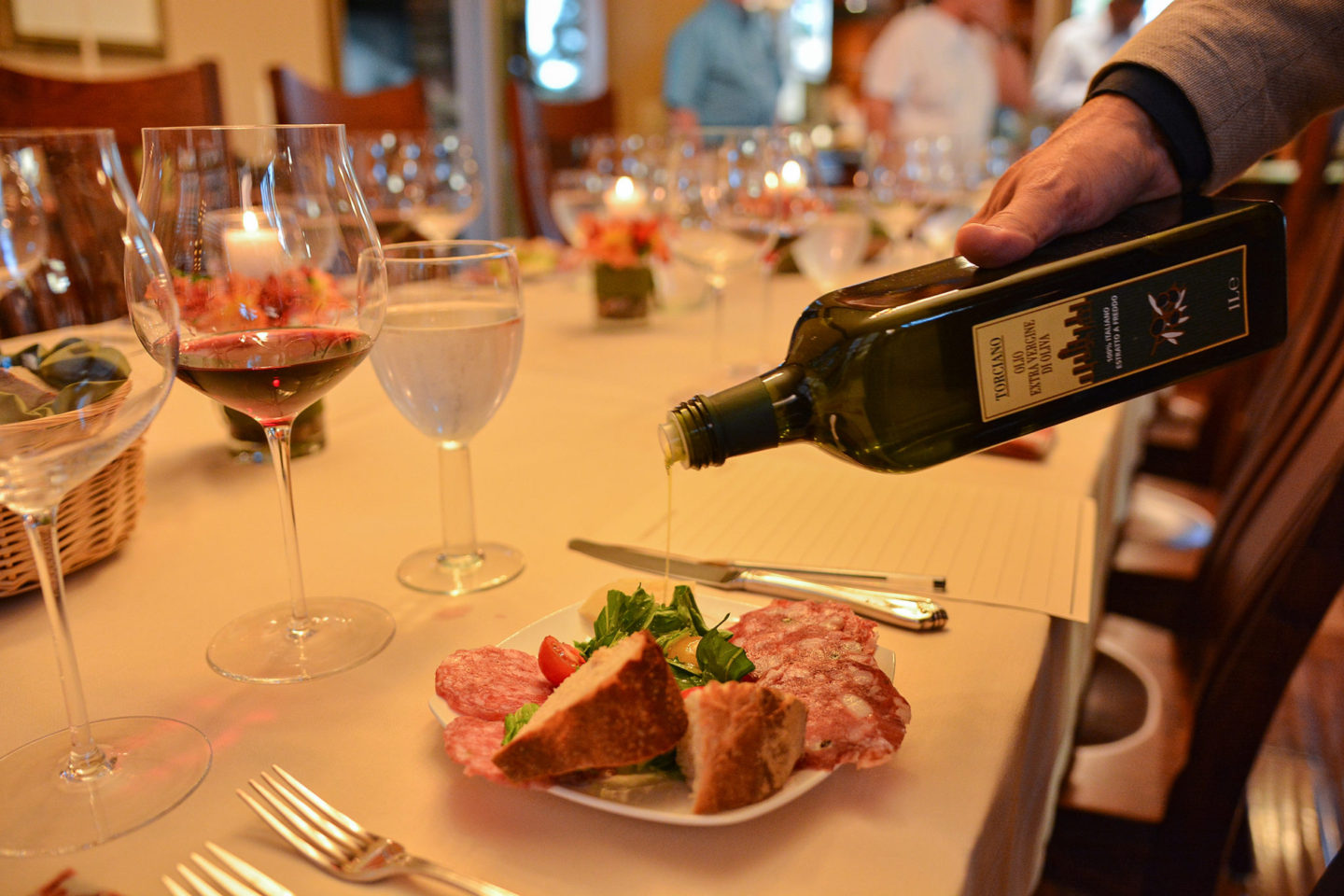
Extra virgin olive oil is a natural source of vitamin E, a powerful antioxidant that protects cell membranes from aging processes. For this property it is considered the vitamin of beauty. The more a food is rich in oxidizable fats, the more it needs quantity of vitamin E to protect them from the formation of free radicals. Therefore, more than assessing how much vitamin E is present in a fat, it is important to evaluate how much there is in relation to oxidizable fats. Finally, thanks to squalene skin cancers would also be counteracted.
Extra virgin olive oil is therefore the most balanced condiment in nature and rich in substances beneficial to the human body. It is also poor in saturated fats, responsible for the increase in cholesterol levels in the blood and directly linked to problems such as the occlusion of the arteries, arteriosclerosis, myocardial infarction. Extra virgin olive oil contains very few, to the benefit of health.
The extra virgin olive oil, as already mentioned, is the basis of the Mediterranean Diet – better if used possibly raw. Finally, even oil conservation has its importance: it must always be bottled in stainless steel or dark glass containers, away from light, air and heat. Try to consume it when it is fresh – aging does not help it but it deprives it of its fragrance, taste and above all of polyphenols, so important for your well-being.
Discover Torciano extra virgin olive oil on our website: https://www.torciano.com/it/shop/library-wine/gourmet/

Author

Luciana Cilemmi
Luciana Cilemmi, deals with Magazine, Style Director and Co-founder of Tenuta Torciano winery and Tenute Giachi wines and the innovative Viviarium Restaurant of Bottega Torciano- Tenuta Torciano & Winery is part of an international reality that is born in Italy by an initiative of Pierluigi Giachi and Luciana Cilemmi, who have worked for years in the Italian wine market , expanding throughout in the United States, managed and controlled by the american company ' Bellavini winery. Luciana Cilemmi was born in San Gimignano to a family of artists specialised in the restoration of medieval buildings. Having completed her technical studies, she now pursues the interests passed on to her by her family, like her passion for artistic objects, in particular works of art created in Tuscany between the Middle Ages and the Renaissance. But she reserves her keenest enthusiasm for the historic works completed in San Gimignano between 1100 and 1300. Alongside her love of medieval history, she is fascinated in wines produced from Tuscan vineyards, which, together with saffron and wool, were the most sought-after goods traded by the wealthy noble families of San Gimignano already in medieval times. Luciana Cilemmi left San Gimignano at the age of 21 and embarked on a pilgrimage in search of knowledge and to discover the new winemaking skills and products that were then developing both in Italy and in France. In the meantime she added to her knowledge of wine by attending specialised courses and becoming a master of wine. On returning to Siena, she discovered a wonderful area near Murlo where she fell in love with the tiny, unspoilt village of Montepescini. She bought the estate of Montepescini where, based on the experience she had acquired over the years, she found a particular lie of the land, special climatic conditions and an altitude suited to the creation of great wines. With enormous enthusiasm, doggedness and considerable effort, a reclamation programme was started to renew the terrain which was then used to plant 30 hectares of specialised vines. Sangiovese is the dominant vine, followed by Cabernet Sauvignon, Merlot and Syrah. Years of experimentation and the introduction of new winemaking techniques eventually led to the creation of Luciana di Memmi’s prestigious wines. Some years ago, Luciana Cilemmi succeeded in realising her dream of a lifetime: to return to her home town, San Gimignano. She was destined to buy the historic palace with the medieval tower, which had been owned by the prestigious Useppi family from 1200 to 1927 and had then passed to the noble and historic Chigi family of Siena. The Useppi were a powerful Sienese family who owned several castles. This beautiful medieval building has an elegant and distinctive façade full of Sienese and Pisan architectural influences. If you find yourself in San Gimignano, make sure you visit the Chigi Tower and Palace. Luciana Cilemmi holds regular events in the rooms of the medieval tower, such as the presentation of wines, both from her vineyards and elsewhere, attended by international journalists, experts from the sector and critics. She also organises exhibitions of works of art and paintings, and press conferences on the subject of "Wine in San Gimignano during medieval times”. Visiting the home of Luciana Cilemmi is like re-living an aspect of the past that will not return except through the imagination of those who have believed and continue to believe in this story.


